Dental Implants in Tirana: Costs, Process and What to Expect
Dental Implants in Tirana: Costs, Process and What to Expect
If you are considering dental implants in Tirana, the first useful step is an individual assessment, not a price list or a promise that treatment can be completed in a set number of days. An implant replaces a tooth root and usually supports a crown, bridge or denture. The right plan depends on the missing tooth or teeth, the condition of your jawbone and gums, your health, and the type of restoration needed. Some people can move through treatment in a relatively straightforward sequence; others need additional care or a longer healing period.
This guide explains how implant treatment is planned, what can affect a quotation, why temporary teeth are different from final restorations, and how to plan if you live outside Albania. It is general information rather than a diagnosis. Only a dentist who has assessed your mouth and relevant medical history can advise whether implants are suitable for you.
What a dental implant actually replaces
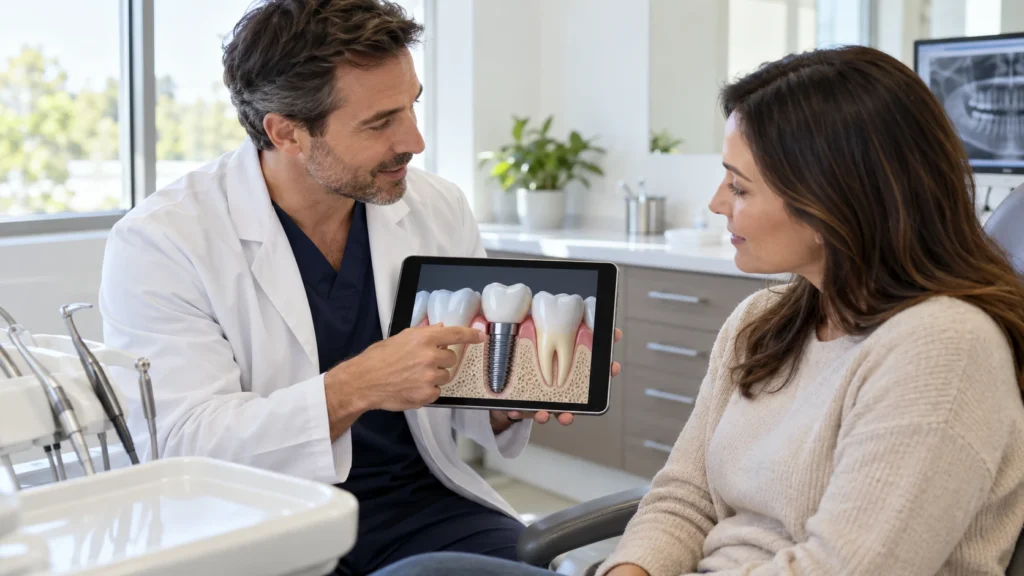
A dental implant is a small fixture placed in the jawbone to act as an artificial root. After healing, a connector called an abutment may support a crown, bridge or implant-retained denture. Replacing a single tooth is different from restoring several teeth or a full arch, so the number of implants is not necessarily the same as the number of missing teeth. The design should be based on the final bite and restoration as well as the available bone.
Implants are one option among several. Depending on the tooth, a dentist may first consider whether it can be restored and preserved. If a tooth is already missing, a conventional bridge or a removable partial denture may be reasonable alternatives. Each has trade-offs in preparation, maintenance, stability, cost and impact on neighbouring teeth. A sound discussion covers the alternatives and why one is recommended for your situation.
How the treatment is assessed
Planning starts with a clinical examination and a review of your dental and medical history. The dentist checks the teeth, gums, bite and the area where the implant might be placed. Imaging helps assess anatomy and bone; the type of scan depends on the clinical question. A panoramic image can be useful for an overview, while three-dimensional imaging may be appropriate when more detail is needed for surgical planning. More imaging is not automatically better: each investigation should have a reason.
Tell the clinician about medicines and supplements, allergies, previous implant or gum treatment, smoking, diabetes and any condition that may affect healing. These details do not automatically rule out implants. They help the team identify risks that may need to be addressed first or monitored more closely. Active gum disease, untreated decay, infection or an unstable bite may need treatment before implant surgery is considered.
A remote review can help a clinic understand your question and decide what records might be useful, but photographs and an old X-ray cannot replace an in-person examination. They also cannot guarantee that the final plan or fee will match an early estimate. If you are sending records from abroad, include the date and type of each image, a short description of your concern and relevant medical information. Avoid sending unnecessary sensitive records to unverified contacts.
The usual stages of implant treatment
| Stage | What may happen | Why the plan can differ |
|---|---|---|
| Assessment and planning | Examination, imaging when indicated, discussion of alternatives and a written sequence of care. | The number and position of teeth, bone anatomy, gum health and bite all matter. |
| Preparation | Treatment of active dental or gum problems; extraction or bone augmentation if clinically needed. | Not every patient needs an extraction, graft or sinus procedure. |
| Implant placement | The implant is surgically placed under local anaesthesia, with other options discussed if appropriate. | Surgical approach depends on the site, anatomy and health factors. |
| Healing | The tissues recover while the bone integrates with the implant; follow-up checks assess progress. | Healing time varies and can be affected by bone quality, procedures and individual health. |
| Restoration | An abutment and final crown, bridge or denture are fitted when the clinician considers it appropriate. | The design, material, number of units and bite influence the laboratory work. |
| Maintenance | Daily cleaning and periodic professional reviews continue after the restoration is fitted. | Recall frequency is individual, especially with a history of gum disease. |
Osseointegration describes the biological connection that develops between the implant surface and surrounding bone. It takes time. In selected situations a temporary restoration can be provided earlier, but immediate loading is not suitable for everyone and does not mean the final teeth are ready. A temporary crown or bridge may have different materials, appearance and function from the definitive restoration. Ask your dentist to identify each one in the treatment plan.
What affects the cost of dental implants in Tirana?
There is no single total that applies to every patient. A useful quotation explains the components rather than giving an unexplained figure for “an implant.” Depending on the plan, the overall fee may include consultation and imaging, surgery, implant fixture, abutment, temporary restoration, definitive crown or bridge, and follow-up visits. Additional procedures may be proposed where necessary. Confirm which items are included, which are charged separately, and what would change the estimate if clinical findings differ from the records provided.
- Number and position of teeth: a front tooth, a back tooth and a full-arch restoration place different demands on design and appearance.
- Bone and gum condition: grafting or periodontal treatment may be considered when examination shows a clinical need.
- Type of restoration: a single crown is not the same laboratory task as a multi-unit bridge or a removable implant-retained denture.
- Temporary teeth and staged treatment: ask whether a temporary restoration is planned and whether it is included.
- Follow-up and maintenance: establish which postoperative checks are part of the plan and how later reviews are arranged.
When comparing clinics, use the same checklist for each quotation. A lower initial amount may omit the restoration, imaging, temporary teeth or a procedure included elsewhere. Compare the clinical rationale, written inclusions, materials identified in the plan, risks discussed and aftercare route. Cost matters, but it does not tell you on its own whether a treatment plan is appropriate.
Travelling to Tirana for treatment
Dental care abroad adds practical questions to the clinical ones. Before booking travel, ask whether the first visit is diagnostic or includes treatment, what records the clinic wants to review, how many visits are anticipated and how much time should be allowed between stages. An estimate based on records is provisional until a clinician examines you. A treatment plan may change if the examination shows infection, inadequate bone, gum disease or another issue that was not visible in the documents.
Do not assume that a complex implant case can be completed in one trip. Some procedures require healing and a later visit before the final restoration is placed. If you are travelling, build flexibility into your itinerary and ask what happens if recovery takes longer than expected. Confirm the clinic’s instructions for urgent concerns and how your dentist at home can receive the treatment summary. Flights, hotels, transfers and other travel services should only be treated as included if they are expressly confirmed in writing.
Art Dent Clinic is based in Tirana. Its implant treatment information describes the service offered, while the clinic’s dental services overview places implant care alongside other treatment areas. For practical questions about planning a visit, review its dental tourism information. These pages are not a substitute for a personal treatment plan or a guarantee of a particular outcome or schedule.
Risks, recovery and aftercare
Implant surgery has risks, as do other surgical procedures. Short-term effects can include discomfort, swelling or bruising. Less common complications may include infection, bleeding, injury to nearby structures, failure of the implant to integrate with bone, or later mechanical and gum problems. The specific risks depend on the site and the person. Your clinician should explain the relevant risks, alternatives and what symptoms need prompt review before you consent.
Follow the postoperative instructions given for your procedure, including guidance on cleaning, medication and activity. Contact the clinic if symptoms worsen, you develop a fever, persistent bleeding, increasing swelling, or a restoration feels loose. Do not try to tighten or adjust implant components yourself. If urgent symptoms arise after you return home, seek timely local dental or medical care and share your treatment details.
Long-term maintenance matters because an implant can be affected by inflammation in the surrounding gums and bone. Clean around the implant every day using the method and tools recommended for your restoration. Keep regular check-ups so a professional can assess the soft tissues, plaque control and restoration. The European Federation of Periodontology’s guidance on preventing peri-implant disease highlights home oral hygiene, professional maintenance and smoking avoidance as relevant preventive measures. The Guy’s and St Thomas’ NHS overview of dental implants also outlines the treatment and potential risks for patients.
Five questions to ask before agreeing to a plan
- What diagnosis supports the recommendation, and what alternatives could preserve or replace the tooth?
- Does the written estimate include the implant, abutment, temporary tooth, final restoration, imaging and planned reviews?
- Are any grafts or other procedures proposed? If so, what finding makes them necessary?
- What is the expected sequence of visits, and which steps depend on healing?
- Who should I contact if I have a concern after returning home, and what records will I receive?
Clear answers make it easier to understand what you are choosing. If any part of the plan is unclear, ask for it to be explained in plain language before treatment begins.
Frequently asked questions
How long does dental implant treatment take?
The total time varies. It includes assessment, any necessary preparation, surgery, healing and placement of the definitive restoration. Some steps can be combined in selected cases, while others must be separated to allow healing. Your clinician can give an estimate after reviewing your case, but it should not be presented as a guaranteed date.
Will I have a tooth while the implant heals?
A temporary tooth or other interim option may be possible, depending on the location, stability, bite and clinical plan. A temporary restoration is not the same as the final crown or bridge and may have restrictions. Ask what you will wear during each phase.
Is implant surgery painful?
Local anaesthesia is commonly used for implant placement, and the team should explain comfort options before the procedure. Some soreness or swelling can occur afterwards. Your own experience depends on the surgery and individual factors; no responsible clinician can promise that every patient will feel no discomfort.
Can everyone have dental implants?
No. Suitability depends on oral health, bone anatomy, medical history, medicines, smoking and other factors. Some conditions can be managed before treatment, while in other cases an alternative may be safer or more suitable. An examination is needed to decide.
Can an implant be placed immediately after a tooth is removed?
Sometimes immediate placement is considered, but it is not appropriate in every case. The socket, infection status, bone, gum tissue and ability to achieve stability all influence the decision. Your dentist can explain whether it is an option for you.
How do I know what the quoted price includes?
Ask for an itemised written plan covering diagnosis, surgery, implant components, temporary and final teeth, possible additional procedures and planned reviews. Ask which charges could arise if the examination reveals something different from the records sent in advance.
How should I clean an implant?
Brush twice daily and clean around the restoration and gumline using the technique and interdental tools recommended for its shape. Keep professional maintenance appointments. Contact a dentist if you notice bleeding, swelling, tenderness or a change in the fit.
Discuss your case before planning travel
Dental implants in Tirana may be worth exploring if the plan is clinically sound, clearly explained and practical to complete and maintain. Start with your records and questions, then confirm the diagnosis and sequence at an examination. You can request an assessment from Art Dent Clinic; any remote estimate should be treated as preliminary until the dentist has examined you.
Medical note: This article is for general education and does not replace a clinical examination, diagnosis or personalised dental advice.
