In-house dental lab: why it matters for crowns and prosthetics
In-house dental lab: why it matters for crowns and prosthetics
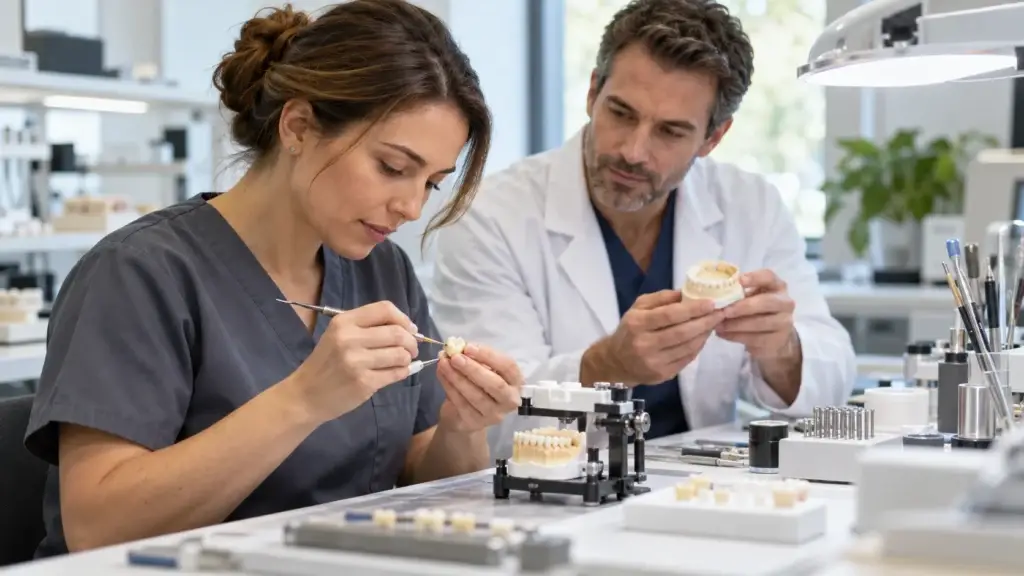
A dental laboratory turns a dentist’s clinical prescription and patient records into crowns, bridges, dentures and other restorations. When a clinic has an in-house lab, the dentist and technician may be able to discuss a case directly, review a shade or shape together, and coordinate adjustments during the workflow. That can make communication more immediate. It does not, by itself, prove that a restoration will fit perfectly, be completed faster, cost less or last longer. The dentist still has to diagnose the problem, choose a suitable treatment and check the finished work in the patient’s mouth.
For a patient comparing clinics or planning a crown, understanding the lab’s role helps turn a vague claim into useful questions: Who designs the restoration? What information is sent to the technician? How are fit, bite and appearance checked? What happens if the first version needs adjustment? This article explains the handoffs and decisions involved, and what an in-house dental lab can and cannot tell you about care at Art Dent Clinic in Tirana.
What does a dental laboratory do?
A laboratory fabricates the prosthetic appliance or restoration prescribed by the dentist. Depending on the treatment, that may be a single crown, a bridge replacing one or more teeth, a removable denture, a provisional restoration or components of an implant-supported prosthesis. The dentist examines the patient, identifies the clinical need, prepares the tooth if required, records the shape and bite, selects or discusses the material, and sends a prescription with the relevant records. The technician uses that information to make a restoration for clinical try-in and adjustment.
The technician’s work is important, but the laboratory does not independently decide whether a tooth needs a crown, whether it can be preserved with a more conservative option, or whether an implant restoration is appropriate. Those decisions depend on examination, imaging where indicated, the patient’s goals and health history. The dentist remains responsible for the diagnosis, treatment plan, fit and final placement. A laboratory can support a plan; it cannot replace the clinical relationship.
From consultation to final placement: the main handoffs
- Diagnosis and design brief. The dentist discusses why a restoration is being considered, what it needs to do and what alternatives exist. The prescription should carry the clinical details the technician needs.
- Records. An impression or digital scan records the prepared tooth and adjacent structures. A bite record, opposing arch, photographs or shade notes may also be needed, depending on the case.
- Fabrication. The technician makes the restoration to the prescription. Different materials and workflows have their own design and manufacturing requirements; the article of treatment should name the proposed material where relevant.
- Clinical try-in. The dentist checks margins, contacts with neighbouring teeth, occlusion, contour, appearance and comfort. A restoration may need adjustment or further lab work.
- Delivery and review. The dentist confirms the restoration is suitable for cementation or another attachment method, gives care instructions and explains when to seek review.
Every handoff can affect the result. An incomplete scan, unclear margin, unrecorded bite or vague shade request may leave a technician guessing. Conversely, a detailed prescription does not guarantee a perfect outcome; the oral environment is complex, and clinical verification is still essential.
Where direct dentist–technician communication can help
When a technician and dentist can talk directly, they may clarify a design detail, review a photograph, discuss a contact point or agree what to change after a try-in. This is particularly relevant when the case involves visible teeth, unusual anatomy, several units or a patient’s specific functional or aesthetic concern. The advantage is a possible improvement in coordination, not a substitute for accurate records and sound clinical decisions.
A clinical study evaluating a structured office–laboratory communication checklist for single crowns found improved crown quality in its study setting. The result supports the value of clear instructions; it does not show that simply having a lab in the same building guarantees the same outcome for every patient. See the study summary on laboratory communication and single-crown quality.
| Part of the process | What coordination may support | Useful question to ask |
|---|---|---|
| Shade and surface appearance | Clarifying photographs, shade notes and the patient’s preference before the restoration is finished. | How will the shade be selected and checked? |
| Fit and contacts | Describing a specific issue found at try-in so the technician can understand the requested change. | What happens if the crown feels tight or does not seat fully? |
| Bite and contour | Explaining where a restoration contacts opposing teeth or needs a contour adjustment. | Who checks the bite before final placement? |
| Changes to the plan | Passing updated clinical information to the laboratory if the dentist revises the design. | Will I be told if the material or design changes? |
What an in-house lab does not guarantee
- A perfect fit on the first try. Some restorations require adjustment. A clinical try-in is part of quality control, not necessarily evidence that something has gone wrong.
- A shorter appointment schedule. Availability, complexity, material, laboratory workload, clinical healing and the number of required visits affect timing. Ask for a case-specific estimate rather than assuming that an in-house lab means same-day treatment.
- A particular material or technology. The phrase “in-house laboratory” does not identify which equipment, materials or manufacturing methods are used for your case. Ask what is actually proposed.
- Longer durability or a warranty. Longevity depends on the clinical condition, restoration design, material, bite, hygiene, habits and follow-up. Any guarantee requires written terms and should be reviewed separately from expected clinical performance.
- That a crown is the right treatment. A crown may be appropriate for a tooth with significant structural damage, but other options may preserve more natural tooth tissue. Ask why it is recommended and what alternatives apply.
Art Dent Clinic states that it operates an in-house dental laboratory and has laboratory personnel listed on its clinic staff page. For an individual case, confirm which parts of your restoration will be made there and who will review the work clinically. Its page on dental aesthetics gives context on aesthetic treatments, while the relevant dental treatment planning in Tirana page may help international patients understand how to coordinate a visit. These pages describe the clinic; they do not replace an examination or a written treatment plan.
Crowns and prosthetics: what should be checked?
For a crown, the dentist checks whether it seats fully, whether the edges are acceptable, whether neighbouring teeth make contact properly, and whether the bite feels balanced. The dentist also considers the contour around the gum and whether the patient can clean the area. A crown that looks attractive but is difficult to maintain may create practical problems. A restoration that feels “high” should be reported so the clinician can assess the bite rather than leaving the patient to adapt to persistent discomfort.
For a bridge, the design must account for supporting teeth, the space being restored and the forces created during chewing. For a removable denture, retention, stability, comfort, speech and cleaning are important. Implant-supported prosthetics add planning around the implant position and attachment system. Each design has benefits and compromises, and “fixed” does not automatically mean superior to a removable option for every person.
Material choice also requires context. Ceramic, zirconia, metal-ceramic and other options have different aesthetic and functional properties. For a broader overview, see the clinic’s dental service options; use the consultation to confirm which material is actually proposed for your tooth. Art Dent describes some examples of its dental crown options; use the consultation to confirm which material is actually proposed for your tooth. The appropriate selection depends on where the tooth sits, the amount of space, bite forces, available tooth structure, gum appearance, allergies or sensitivities, and the clinician’s assessment. A material name alone does not describe the quality of the design, fit or maintenance plan. Ask what material is proposed, why it suits the location and whether a less invasive option is reasonable.
Before agreeing to a crown or prosthetic plan
A consultation should leave you able to explain the goal of treatment in your own words. These questions can help structure the discussion:
- What is the diagnosis, and what is the reason for a crown, bridge or denture in my case?
- Can the tooth be restored with a more conservative treatment?
- What material is proposed, and what are its practical benefits and limitations?
- Which records will be taken, and how will the bite and shade be documented?
- Who will make the restoration and who will check it at the try-in?
- How many appointments are expected, and what might change that estimate?
- What is included in the written quotation, and are adjustments or temporary restorations itemised?
- What should I do if the restoration feels uncomfortable after placement?
If you are travelling to Tirana, request a written outline of the proposed stages before arranging travel. A preliminary remote discussion can help identify questions, but the final plan may change after an in-person examination, imaging or updated records. For extensive treatment, ask what follow-up may be needed after returning home and how records can be shared with a dentist near you.
Care after a crown or denture is fitted
A restoration still needs regular cleaning and professional review. Brush along the gumline, clean between teeth and under a bridge with an appropriate aid recommended by your dentist, and follow the instructions for a removable denture. A crown does not make the supporting tooth immune to decay, and the gum around any prosthesis can become inflamed. If you have an implant-supported restoration, daily cleaning needs to reach the implant and prosthetic contours; the design should allow access.
Contact the clinic if the restoration becomes loose, cracks, causes persistent pain, traps food in a new way or changes your bite. Do not try to file, glue or adjust it yourself. Some early awareness can occur as you adapt, but persistent or worsening symptoms deserve assessment. Keep copies of your treatment plan, material details and any laboratory or implant information that may help with future care.
Frequently asked questions
Does an in-house lab mean I will receive my crown faster?
It may help coordination, but appointment time also depends on the clinical plan, the restoration, materials, workload, healing and whether adjustments are needed. Ask for an estimate based on your case.
Will I meet the dental technician?
That depends on the clinic’s workflow and your case. In some situations, direct discussion can help with shade or design preferences. Ask whether the dentist or technician will review your concerns and how they will be recorded.
Does the lab choose the crown material?
The dentist should discuss the clinical options and prescribe a material suited to your situation. The technician contributes to fabrication, but the treatment decision should be explained by the dentist.
Is an in-house laboratory proof of better quality?
No single organisational feature proves the quality of an individual restoration. Clear records, a suitable prescription, skilled fabrication and clinical checks all matter. Ask how each stage is handled.
What if the crown does not fit at the first try-in?
The dentist assesses the fit and determines whether adjustment, a new record or further fabrication is needed. Do not accept persistent pain or an unbalanced bite as something you must simply tolerate.
Can the lab make a crown without an examination?
No. A restoration requires diagnosis and patient-specific records. Photos or old scans may support discussion, but they cannot replace the clinical assessment needed to select and fit treatment.
How long will a crown or denture last?
There is no single lifespan for every restoration. Material, design, oral health, bite, cleaning and maintenance all matter. Your dentist can explain expected care and signs that should prompt a review.
Conclusion
An in-house dental lab can give a clinic and technician a direct channel for discussing restoration details, but a successful crown or prosthesis depends on the full chain: diagnosis, records, prescription, fabrication, clinical fit checks and continuing care. At Art Dent Clinic in Tirana, patients can ask how its laboratory will contribute to a specific plan, which material is proposed and what happens if adjustments are needed. A consultation is the right place to compare options and receive a written plan based on your teeth and goals.
