All-on-4 vs All-on-6 in Albania: which option is right?
All-on-4 vs All-on-6 in Albania: which option is right?
All-on-4 and All-on-6 are names commonly used for full arch bridges supported by four or six dental implants. The number alone does not determine which plan is safer, stronger or more suitable. Implant position, bone anatomy, bite, health, cleaning access and the design of the final bridge all matter. A dentist must assess the individual jaw before recommending a technique.
Patients comparing treatment in Albania should also distinguish the surgical plan from the temporary and definitive teeth, and understand how follow-up will work after travel. This guide explains what the names mean, what may influence the choice, how to compare a written treatment plan and which questions to ask at a consultation in Tirana.
What do All-on-4 and All-on-6 describe?
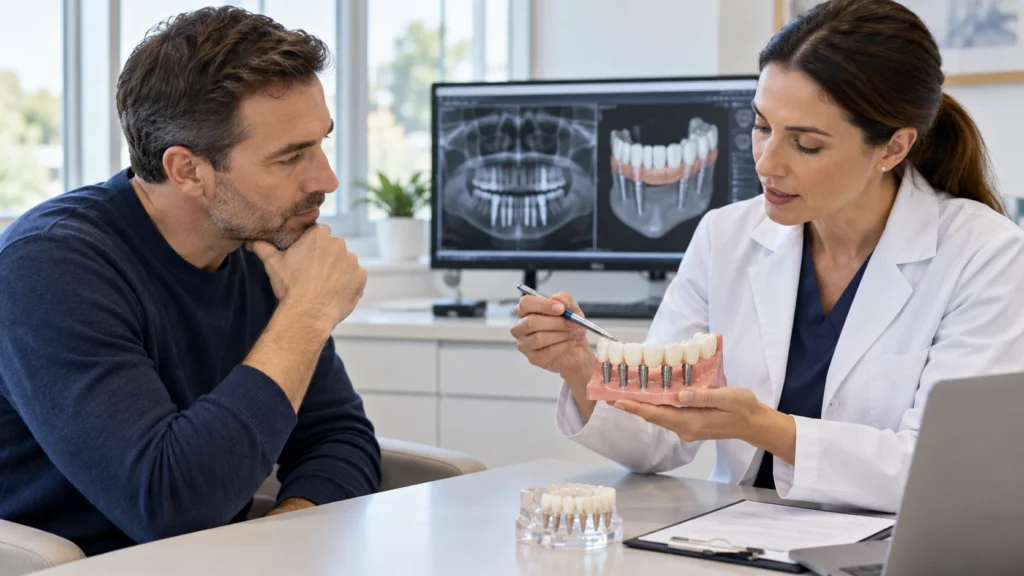
Both approaches use implants placed in the jaw to support a fixed full arch prosthesis. The familiar “four” or “six” refers to the number of implants supporting that arch in a particular treatment concept. In some plans, posterior implants are angled to use available bone and avoid anatomical structures; this is a clinical design choice, not a shortcut that suits every patient. The finished teeth are usually connected as a single bridge or segmented prosthesis, depending on the plan.
The label does not tell you implant length, diameter, distribution, material, expected healing, whether bone grafting is needed or how the bridge will be maintained. Nor does it automatically mean that teeth can be attached on the day of surgery. Ask the clinician to show how the proposed positions relate to your own scan and bite, and what would make them change the plan during surgery.
Why might a clinician consider four or six implants?
Four implants can support a full arch in selected cases when their position and the prosthesis design provide a suitable distribution of support. Six may be considered where anatomy and restorative design allow additional support or where the clinician has specific biomechanical reasons. A higher number is not automatically an improvement: implant placement must preserve adequate bone, respect nerves and sinuses, allow a cleansable restoration and avoid creating unnecessary surgical burden.
Bone volume and quality, arch shape, opposing teeth, force of the bite, bruxism, whether one or both arches are treated, and the material and span of the bridge can all influence the plan. A patient with a history of gum disease, smoking, poorly controlled medical conditions or medicines affecting healing may need risk management before implant surgery. Some factors can be modified; others may lead the clinician to propose a different design, staged treatment or a non-implant alternative.
| Factor | How it can affect planning | Question to ask |
|---|---|---|
| Bone anatomy | Available height, width and proximity to nerves or sinuses affect safe implant positions. | What does my imaging show, and is grafting or another approach indicated? |
| Bridge design | Length, material, cantilever and cleaning space affect forces and maintenance. | What restoration will the implants support, and how will I clean beneath it? |
| Bite and habits | Clenching or grinding and opposing teeth may increase mechanical demands. | Does my bite need treatment or a protective night appliance? |
| Health and gum history | Healing and inflammation risk can be influenced by health, tobacco and periodontal history. | What needs to be stabilised before surgery and how will risk be monitored? |
| Provisional teeth | Immediate loading depends on stability and other case-specific conditions. | Will I have temporary teeth, and what are the limits while healing? |
Is there evidence that one number is always better?
No universal rule can be inferred from the name alone. Systematic reviews compare outcomes across studies, but research populations, jaw location, implant designs, follow-up periods and prostheses differ. A review of complete arch rehabilitation reported that the number of implants should not be treated in isolation from the full clinical and prosthetic plan; the available studies do not establish that every patient benefits from the same count. The systematic review on the number of implants for complete arch prostheses is one source clinicians may consider, while recognising the limits of combining varied study designs.
What matters for you is whether the proposed plan is supported by your anatomy, whether the bridge can be cleaned and maintained, and how the clinician will manage a complication. Ask for the rationale in plain language. If two qualified clinicians recommend different numbers, compare their imaging assessment, restoration design, risks and alternatives rather than assuming that “more” or “fewer” implants settles the question.
How assessment and treatment usually proceed
- History and examination. The dentist reviews health conditions, medicines, gum status, remaining teeth, bite and treatment goals. Existing teeth should be assessed for whether they can be retained.
- Imaging and planning. X-rays and, when indicated, three-dimensional imaging help assess anatomy and plan positions. A scan is interpreted with a clinical examination, not used as a stand-alone diagnosis.
- Written options. The team explains alternatives, implant number and positions, provisional and final prostheses, expected stages, maintenance, risks and costs.
- Surgery and provisional phase. If suitable, implants are placed. Whether a temporary fixed bridge can be attached promptly depends on clinical stability and other factors. In some cases a removable or other temporary solution is safer during healing.
- Healing and definitive restoration. The implants need time to integrate with bone. After review, the final bridge is designed, fitted and adjusted. Follow-up is necessary to check comfort, bite and tissue health.
Healing time varies and may be longer if extractions, infection control or bone grafting are needed. The patient information from Guy’s and St Thomas’ NHS Foundation Trust explains that assessment, grafting and implant healing can add stages. A fixed bridge placed early is provisional when it is intended to be replaced later; ask when and how the definitive restoration will be made.
What should be included in a comparison of costs?
The overall price can depend on imaging, extractions, grafting, sedation if offered and clinically appropriate, implant components, temporary teeth, definitive bridge material, laboratory work and review visits. Ask whether the quote is per arch and whether it includes both jaws if you are considering a full mouth rehabilitation. A price for four implants cannot be compared fairly with a package that includes a different prosthesis or additional procedures without examining what each contains.
Request an itemised written estimate and ask what could change after the in-person examination. Confirm what is included in any warranty or service policy, how long it lasts, what maintenance is required and whether travel or repair costs are excluded. A warranty is not a promise that biological healing or a prosthesis will never have a problem.
Full arch treatment in Albania: plan follow-up as carefully as surgery
Before travelling to Tirana, send the records requested for an initial review and treat any remote estimate as provisional. Ask how many visits are expected, how much time may be needed in Albania, what can only be confirmed in person and whether a return trip is likely. Do not arrange flights around a promise that “fixed teeth in a few days” applies to every case. Healing is biological, and a complication may require additional assessment or a changed schedule.
Ask for copies of your clinical notes, images, implant system details, restoration materials and written aftercare instructions. Agree on how to contact the clinic if you develop pain, swelling, bleeding or a loose component after returning home. Identify a local dentist who can assess urgent symptoms, while recognising that another clinician may need to review the case before taking on ongoing care. The NHS checklist for treatment abroad recommends considering complications, aftercare and the cost of return travel as part of the decision.
Art Dent Clinic is based in Tirana. Read about its implant services, the broader dental services and practical details for dental tourism in Tirana. To ask about an individual case, use the quote request page and include relevant dental records. The clinic’s general English website provides further information, but a final plan requires examination.
Maintenance after the bridge is fitted
Implant-supported teeth need daily cleaning and regular professional checks. The team should show you how to clean below the bridge, around each implant and along the gum margin, using brushes or other tools suited to your restoration. A night guard may be recommended for some patients who clench or grind. Follow-up intervals should reflect gum health, previous periodontal disease, smoking, cleaning ability and the condition of the prosthesis.
Bleeding, swelling, persistent bad taste, worsening pain or movement in the bridge should be assessed. Do not try to tighten a loose component yourself. The European Federation of Periodontology guideline on peri-implant disease highlights prevention and structured maintenance to help protect the tissues around implants.
Frequently asked questions
Does All-on-6 give more stability than All-on-4?
Not automatically. Stability depends on implant position, bone, bridge design, bite and clinical circumstances. A dentist should explain why the proposed plan is appropriate for your jaw rather than relying on the count in the name.
Can All-on-4 be used when there is bone loss?
Some designs may use available bone differently, but bone loss does not make a particular technique automatically suitable. Imaging, anatomy, health and restoration planning determine whether grafting or another option is needed.
Can I receive fixed teeth on the day implants are placed?
Some patients may receive a provisional fixed bridge early, but immediate loading is not suitable for everyone. The clinician assesses implant stability, infection, bone and bite. A temporary bridge is different from the final prosthesis.
Which approach costs less?
There is no reliable general price comparison. Costs depend on the full plan, including surgery, materials, provisional and definitive teeth, imaging, grafting and follow-up. Compare itemised estimates for the same clinical outcome.
Can treatment be completed during one visit to Albania?
Not necessarily. Surgery, healing, fitting the final bridge and maintenance may require separate stages and return visits. The schedule depends on diagnosis and healing, not the destination.
What if I have a complication after returning home?
Agree in advance how to contact the treating clinic and obtain your records. Discuss a local urgent-care plan before treatment and seek prompt assessment for increasing pain, swelling, persistent bleeding or a loose restoration.
Choose the plan that fits your clinical findings
All-on-4 and All-on-6 are starting labels for a clinical discussion, not a contest with a universal winner. The right plan should explain implant positions, bridge design, alternatives, healing, maintenance and risks in relation to your own anatomy. If you are considering treatment in Albania, ask for a written proposal and time to review it before arranging travel. A personalised assessment can help you understand the available options; the final recommendation should be based on examination and informed consent.
If some teeth remain, ask whether any can be restored and kept before considering removal. A full arch implant bridge should not be planned simply because it is a familiar package: the clinician needs to explain the prognosis of each tooth and why a broader replacement is justified.
