Full-mouth dental implants in Albania: what patients should know
Full-mouth dental implants in Albania: what patients should know
Full-mouth implant treatment can replace many missing or severely damaged teeth with fixed or removable implant-supported teeth. It is a major, individualised treatment plan rather than a single procedure, and suitability can only be confirmed after a clinical examination and appropriate imaging. Patients considering Albania should compare the diagnosis, proposed stages, temporary and final teeth, aftercare arrangements and total costs, not simply the number of implants or the headline price.
Some people use “full mouth implants” to mean a complete upper and lower rehabilitation; others mean a fixed bridge replacing one entire arch. These are not interchangeable plans. The following guide explains the terminology, assessment, possible stages, limitations and practical questions to ask before arranging treatment in Tirana.
What does full arch implant treatment involve?
A dental implant is a fixture placed in the jaw to support a crown, bridge or denture. For an edentulous arch, several implants may support a full arch bridge. A removable overdenture can also attach to implants while still being taken out for cleaning. The number and position of implants depend on the available bone, bite, anatomy, design of the restoration and the clinician’s assessment. A treatment name such as All-on-4 describes a particular implant-supported approach; it does not mean every patient is suitable or that the same design is appropriate in every mouth.
Replacing every tooth in both jaws may involve two separate arch plans and may be staged. A person with some healthy teeth may not need their removal. Preserving natural teeth should be considered where clinically reasonable; implants are not automatically better than repairing a tooth or replacing only those teeth that cannot be retained.
Who might be considered, and what is assessed?
Implant-supported full arch treatment may be considered when many teeth are missing or have a poor prognosis and a patient wants a fixed or more stable prosthetic option. Assessment considers oral and general health, gum condition, bone volume, bite forces, ability to clean the restoration, smoking, medications and expectations. Diabetes control, a history of periodontal disease, some medicines and tobacco use may affect planning or healing. These factors do not always rule treatment out, but they need to be discussed with the clinician.
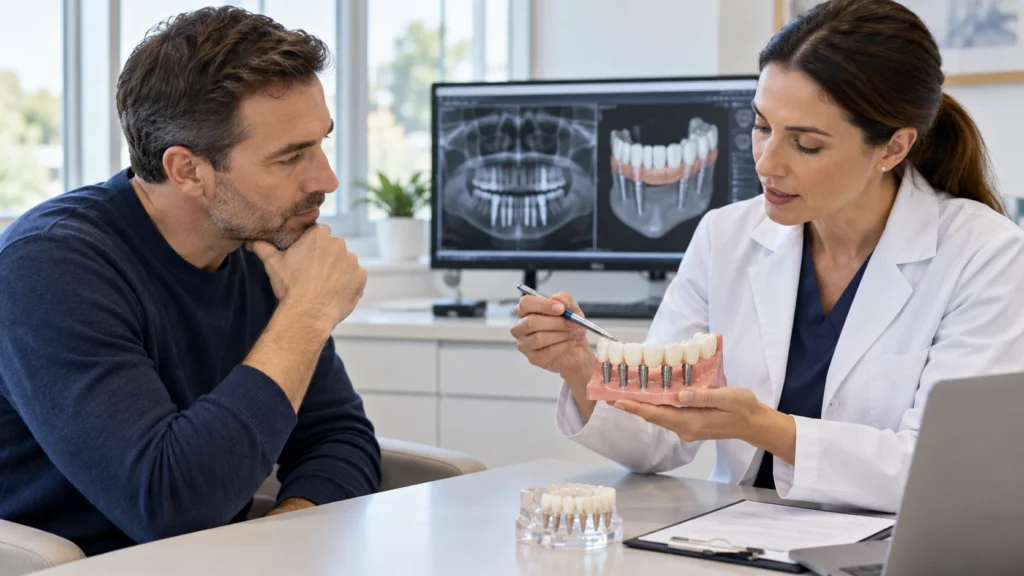
A proper assessment can include a medical and dental history, examination of teeth and gums, photographs, bite records and radiographs. Three-dimensional imaging may be recommended when needed to assess anatomy and plan implant positions. Imaging is interpreted alongside the examination; a scan alone does not establish a complete diagnosis.
| Planning question | What the team needs to understand | Why it matters |
|---|---|---|
| Can natural teeth be kept? | Which teeth are restorable, and what is their gum and root condition? | Removing teeth is irreversible; alternatives should be considered before extraction. |
| Is there adequate bone? | Bone height, width, density and nearby anatomical structures. | These influence implant position and whether grafting or a different design is considered. |
| What restoration is planned? | Fixed bridge or removable overdenture; provisional and definitive stages. | Cleaning, function, repair and cost differ between designs. |
| Can the patient maintain it? | Dexterity, access for cleaning, gum health, smoking and recall attendance. | Implants and prostheses require ongoing professional and home care. |
Typical stages of treatment
- Consultation and diagnosis. The clinician reviews health history, examines the mouth and explains the findings, alternatives and uncertainties. Remote photographs or X-rays can assist initial triage but cannot replace the in-person assessment.
- Planning. The team agrees the intended outcome and discusses whether teeth can be retained, how many implants may be needed, the restoration design, materials, staged procedures and maintenance.
- Surgery, if indicated. Implants are placed under local anaesthesia, with sedation only where separately assessed and available. Extractions, grafting or other procedures may be recommended, each with its own risks and recovery.
- Healing and provisional restoration. The implants need time to integrate with bone. A temporary restoration may be used, but its design and loading depend on stability and clinical circumstances. Immediate or early loading is not suitable for everyone.
- Definitive teeth and review. Once healing and the clinical checks support it, the final prosthesis can be made and fitted. Bite adjustment, hygiene instruction and ongoing review remain part of care.
Healing periods vary. An implant may fail to integrate, and a plan may need to be delayed or changed. Bone grafting can add months to a pathway. The patient information from Guy’s and St Thomas’ NHS Foundation Trust describes assessment, possible grafting and the staged nature of implant treatment. A clinician should explain how these general principles apply to your case.
Fixed bridge or removable implant overdenture?
A fixed bridge stays in place and is removed by a clinician for certain repairs or maintenance. It can feel more like fixed teeth, but cleaning beneath it requires instruction and suitable tools. An implant-retained overdenture is removed by the patient for cleaning; it may still move more than a fixed bridge and attachment components may need replacement. Some patients prefer removability because of hygiene, anatomy or cost, while others may be candidates for a fixed restoration. Neither design is universally superior.
| Feature | Fixed full arch bridge | Implant-retained overdenture |
|---|---|---|
| Removal | Usually removed by the dental professional. | Patient removes it for daily cleaning. |
| Cleaning | Needs careful cleaning under the bridge and around implants. | Allows direct access to the tissue-bearing surface and attachments. |
| Maintenance | May require professional cleaning, repair or screw/component service. | Attachments can wear and may need replacement or adjustment. |
| Suitability | Depends on bone, implant distribution, hygiene access and bite. | Depends on support, retention needs, anatomy and patient preference. |
Benefits, limitations and risks
For an appropriately selected patient, implant-supported teeth can improve retention compared with a conventional denture and restore chewing function. A fixed restoration avoids taking teeth out for routine cleaning. These potential benefits need to be weighed against surgery, cost, maintenance and the possibility of complications. Implants do not develop tooth decay, but the surrounding tissues can become inflamed or infected. Bone loss, prosthesis fracture, loosening, speech adaptation and discomfort can occur. A failed implant may require treatment and can affect the restoration. There can also be an adjustment period while speaking and chewing with a new prosthesis. Ask which foods to avoid during healing and how the bite will be checked if one side feels higher or the restoration seems to move.
There is no responsible way to promise a permanent result or a painless recovery. The expected outcome depends on diagnosis, surgical planning, healing, prosthesis design, hygiene, risk factors and regular follow-up. A dentist should explain the risks and alternatives in terms you understand before you consent.
Planning treatment in Albania
For international patients, arrange the clinical discussion before booking non-refundable travel. Send the records requested by the clinic, but treat any remote estimate as provisional. Ask what will be confirmed only after examination, how many appointments are expected, which stages may require another visit, how long you should remain nearby after surgery and how urgent concerns will be handled after you return home.
- Request an itemised plan showing diagnosis, procedures, provisional and final prostheses, imaging, medicines and review visits.
- Ask for the names and roles of the clinicians responsible for surgery, prosthetics and follow-up.
- Clarify what is included in the quote and what could change it, including grafting, extractions, repairs or additional imaging.
- Obtain copies of X-rays, treatment notes, implant system details, material information and written aftercare instructions.
- Make a local follow-up plan at home before treatment. Do not assume a dentist near you will take over a complex case without reviewing it.
The NHS treatment abroad checklist advises patients to investigate qualifications, possible complications, aftercare and the cost of return travel. These are useful questions for any cross-border healthcare decision. Art Dent Clinic is located in Tirana and sees local and international patients. Start at the English version of the clinic website, then review its dental implant service, broader dental services and dental tourism information to prepare questions. A personalised enquiry can be sent through the quote request page; a remote review is not a final diagnosis.
Long-term care is part of the treatment
Full arch restorations require daily cleaning and professional maintenance. The dental team should demonstrate how to clean around implants and under a bridge, recommend suitable brushes or other aids, and set a review schedule based on risk. Report persistent bleeding, swelling, a bad taste, pain, a loose component or a change in how the bite feels. Do not wait for the next routine visit if symptoms are worsening.
The European Federation of Periodontology guideline on peri-implant disease emphasises prevention, identifying risk factors and structured maintenance. The exact recall interval should be tailored by the treating dentist, especially for patients with previous gum disease or difficulty cleaning the prosthesis.
Questions patients often ask
How many implants support a full arch?
There is no single number for every patient. Implant count and position depend on anatomy, bone, bite, restoration design and clinical judgement. The name of a technique should not replace an explanation of why it fits your case.
Can I leave with fixed teeth on the day of surgery?
Some selected cases may receive a provisional fixed restoration soon after surgery, but immediate loading is not appropriate for everyone. The clinician must assess implant stability, bone, infection, bite and other factors. A provisional restoration is not the same as the definitive prosthesis.
How long does full arch treatment take?
It varies from weeks to several months or longer depending on extractions, healing, grafting and restoration stages. Travel should be planned around the clinician’s assessment, not a generic advertised timetable.
Are full-mouth implants better than dentures?
They may offer greater retention for some people, but they involve surgery, cost and maintenance. Conventional dentures, partial treatment or preserving some natural teeth may be appropriate alternatives.
Does implant treatment hurt?
Local anaesthesia is normally used for implant surgery; post-operative soreness and swelling can occur. Your clinician should explain expected recovery and safe pain relief for your medical history. Contact the clinic if symptoms are severe or worsening.
What happens if I have a problem after returning home?
Before treatment, agree how to contact the clinic, obtain records and coordinate with a local dentist. Ask who pays for assessment or travel if a complication needs in-person care; do not rely on vague assurances.
Make the plan specific to your mouth
Full arch implant treatment can be useful when the diagnosis supports it and the patient understands the stages, alternatives, maintenance and risks. Ask for a written plan that distinguishes temporary from definitive teeth and sets out how care will continue after travel. To discuss an initial case review with Art Dent Clinic in Tirana, share relevant records through its quote request page. The final recommendation should follow an examination and an informed discussion with the treating dental professional, based on your own goals and health history.
